At the UN Ocean Conference (UNOC3), 9-13 June 2025, Mercator Ocean International unveiled the next-generation European Digital Twin of the Ocean (EU DTO), an advanced AI-powered platform designed to simulate and explore “what-if” scenarios that reveal the potential impacts of our decisions —past, present and future — on the marine environment and the socio-economical activities. As a major outcome of the European Commission’s Ocean Pact announced at UNOC3, the DTO transforms Europe’s call for collective action into a powerful digital infrastructure for international cooperation, informed decision-making, and bold strategies for ocean sustainability.
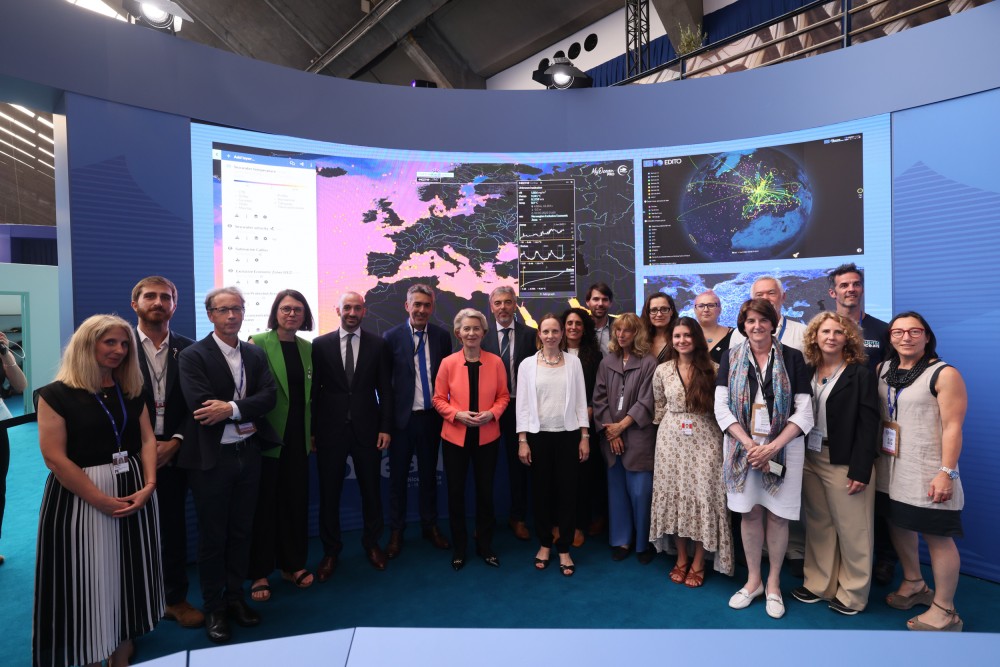
Europe, led by European Commission President Ursula von der Leyen, unveiled the new version of the Digital Twin of the Ocean at the UN Ocean Conference (UNOC3) in Nice. Photo: Phillippe Fitte (Mercator Ocean International)
A collaborative European platform open to all
Developed under the European Commission’s leadership and implemented by Mercator Ocean International, with key partners such as the Flanders Marine Institute (VLIZ), the EU Digital Twin Ocean brings together cutting-edge science, technology, and expertise from across Europe to build its core infrastructure. The DTO is an open, public good, accessible to all stakeholders – from policymakers to citizens. By translating complex marine data into actionable intelligence, it supports Europe’s commitment to transparency, innovation, and the public good.
Harnessing advanced technology and AI
Leveraging Europe’s world-class scientific assets, the DTO integrates data from Copernicus Marine Service, European Marine Observation and Data Network (EMODnet) and other sources to provide consistent, multi-dimensional ocean descriptions and forecasts – from seasonal to multi-decade timescales.
Next-generation artificial intelligence, running on advanced GPU computers, delivers forecasts in seconds rather than hours, while using a fraction of the energy required by traditional supercomputers. AI-driven models have already improved ocean current prediction accuracy by more than 20%, setting a new benchmark for marine forecasting.
Real-world impact: from biodiversity to coastal protection
The DTO is designed as a practical tool for policymakers, environmental agencies, researchers, and communities, enabling informed decisions for people and the planet, on challenges such as marine biodiversity, coastal erosion or marine pollution.