Can tiny sand mason worms help protect our coastline from erosion? In an innovative field experiment, Flemish researchers investigate how these remarkable marine engineers can be encouraged to settle on vulnerable beaches using specially designed artificial substrates. While ILVO scientists study how the worms establish new colonies and stabilise the sediment, researchers from VLIZ are mapping the forces of the sea. After all, understanding why species succeeds in one place but not another, starts with understanding the waves, currents and turbulence that shape the coastal environment.
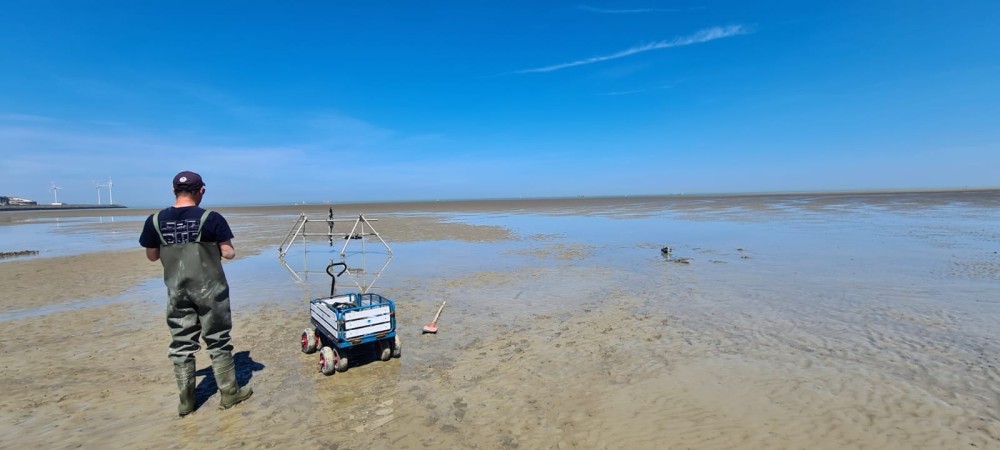
@ VLIZ | Christophe Maier
Nature's own coastal engineers
At low tide, you may have spot small tubes protruding from the sand on the beach. They belong to the sand mason worm (Lanice conchilega), an inconspicuous species that plays a role in shaping the coastal environment. By building dense aggregations of sand tubes, these worms stabilise the seabed, trap sediments and reduce erosion, while at the same time creating valuable habitat for a wide range of marine species. That makes the sand mason worm a true ecosystem engineer with considerable potential for nature-based coastal protection.
As part of the Coastbusters-LANICE project, the Flanders Research Institute for Agriculture, Fisheries and Food (ILVO) is investigating how these worms could contribute to a more sustainable coastal management. Researchers tested biodegradable settlement mats at three locations – Baai van Heist, Raversijde and Lombardsijde – to encourage sand mason worm larvae to settle. The first results suggest that several of the mats provide an attractive substrate for juvenile worms.
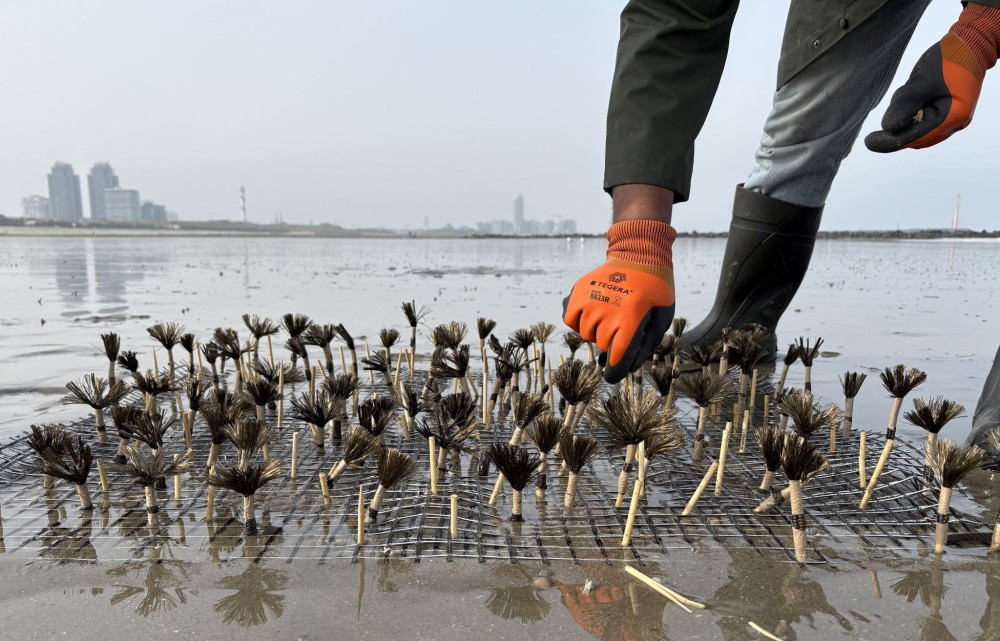
Detail of one of the four mat substrates (Basaltex grid + Basaltex rope) used in the experimental setup at each of the three test sites. @ILVO
Understanding the environment
Whether sand mason worm larvae successfully establish themselves depends on more than the settlement mats alone. Waves, currents and turbulence all influence where larvae settle and survive. To capture these environmental conditions, the VLIZ Marine Robotics Centre monitored the physical environment at all three field sites throughout the experiments.
"Only by integrating the physical processes of waves, currents and turbulence we can correctly interpret the results of the biological experiments," says Leandro Ponsoni, researcher at the VLIZ Marine Robotics Centre. "Deploying scientific instruments in the intertidal zone of the North Sea is far from straightforward, but that's exactly what makes these measurements so valuable."
A robust set-up in challenging conditions
The Flemish coast is a very dynamic environment to work on. Waves, tides, strong currents and rapidly changing weather create demanding conditions for scientific observations. To overcome these challenges, VLIZ engineers designed and built a monitoring structure specifically for this project. Aluminium poles were driven deep into the seabed and connected with scaffolding clamps to create a rigid frame capable of withstanding the harsh conditions of the surf zone. At the same time, the structure was carefully designed to minimise disturbance to the natural water flow, ensuring that the measurements reflected the environment without influencing the experiment itself.
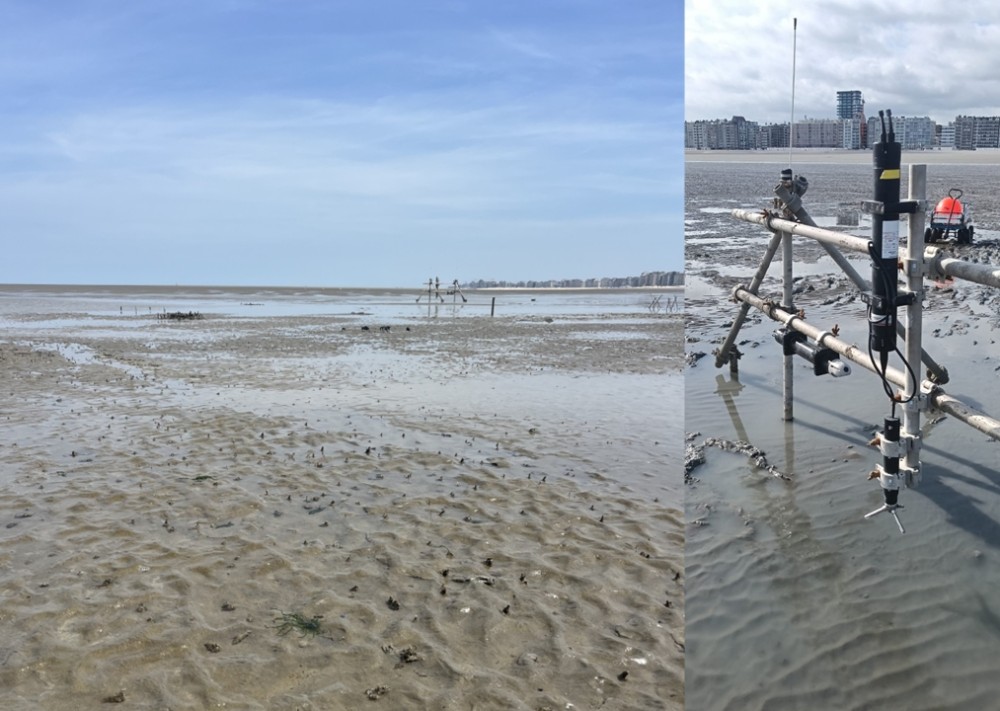
Left: Experimental setup in the Baai van Heist, with the tubes of shell-dwelling tube worms in the foreground. @ VLIZ | Ine Moulaert. Left: Detail of the setup with sensors fitted. @ VLIZ | Leandro Ponsoni.
The monitoring system included high-end instruments such as a Nortek Vector, Aquadopp and an Acoustic Doppler Current Profiler (ADCP), recording waves, currents and turbulence at exceptionally high resolution. One of the sensors collected up to sixteen measurements every second only a few centimetres above the seabed, allowing researchers to detect subtle changes in water movement that may influence where sand mason worm larvae settle.
The field campaign has now been completed and all instruments have been recovered. After downloading the large datasets, VLIZ has begun the next phase of the project: processing millions of data points using specialised analytical techniques. These environmental data will provide ILVO with the information needed to interpret the results of the settlement experiments.
Together, ILVO and VLIZ demonstrate how ecology and physical oceanography complement one another. While ILVO investigates how sand mason worms can help strengthen the coast naturally, VLIZ provides the environmental context needed to understand why these ecosystem engineers succeed in some places and not in others. By combining both disciplines, the project brings nature-based coastal protection one step closer to practical application. Project partner KU Leuven, will be working with both these physical and biological data in the computational environment, upscaling punctual measurements for the entire Belgian coast through numerical models.
The Coastbusters-LANICE research project is a four-year project, funded by VLAIO and supported by the Blue Cluster in terms of commercialisation and industry networking.
Contact
- Leandro Ponsoni – VLIZ
- Gert Van Hoey – ILVO