The Flanders Marine Institute (VLIZ) proudly announces that Dr Gert Everaert, its vice research director and manager of the Ocean and Human Health research group, has received the prestigious Laureate of the Academy Prize in Natural Sciences from the Royal Flemish Academy of Belgium for Science and the Arts (KVAB).
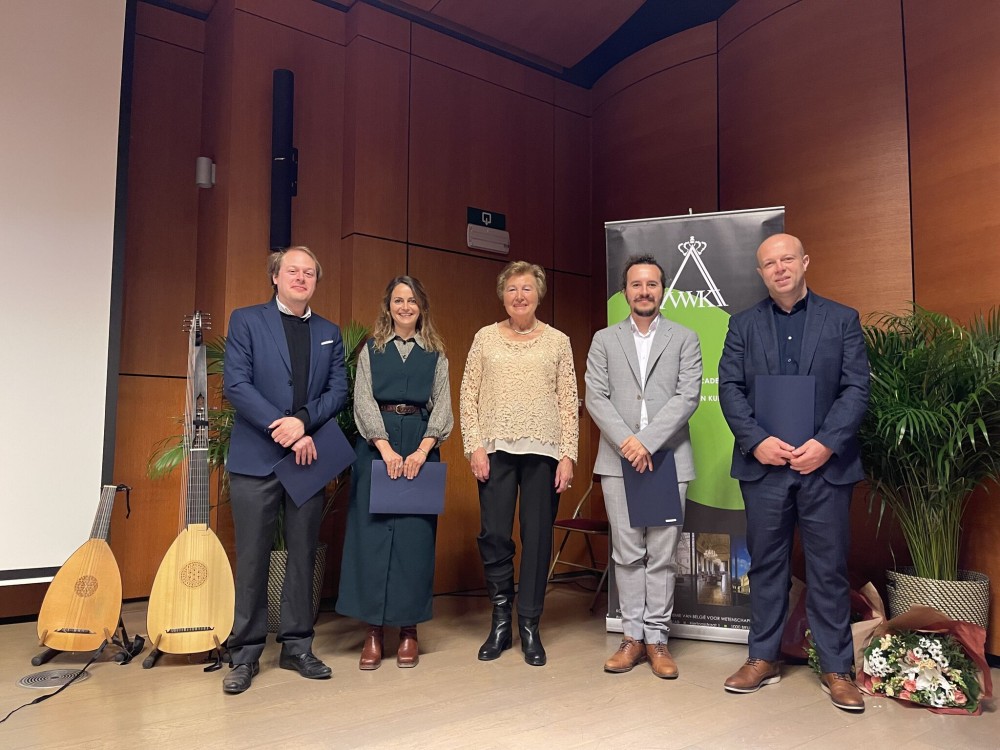
Award ceremony for 'Laureate of the Academy 2025' at the General Public Meeting of the KVAB – with Gert Everaert on the right in the photo.
Dr Gert Everaert has been awarded the Laureate of the Academy Prize in the class of Natural Sciences (2025) by the Royal Flemish Academy of Belgium for Science and the Arts (KVAB). This highly regarded prize is awarded annually to outstanding early-career researchers under the age of 40, in recognition of exceptional scientific achievements. The prize, worth 10.000 Euro, is considered one of the most prestigious academic distinctions in Flanders.
As vice research director at the Flanders Marine Institute (VLIZ) and head of its Ocean and Human Health research group, Gert Everaert plays a key role in advancing multidisciplinary marine research. He leads a large and diverse team of around thirty researchers, fostering collaboration across disciplines to address pressing environmental and societal challenges.
His research focuses, among other topics, on plastic pollution in marine ecosystems and on the complex interactions between ocean health and human health. Through this work, Everaert contributes to a better understanding of how marine environmental pressures affect ecosystems and societies, and how science can inform sustainable solutions.
The Laureate of the Academy Prize recognises not only Everaert’s excellent scientific output, but also his strong commitment to connecting research with real-world impact.
VLIZ is particularly proud of this recognition of its Vice Director of Research and feels honoured, as an employer, to have Gert Everaert among its ranks. He is widely regarded as an inspiring scientific leader and a dedicated manager of a large and dynamic research team.
Motivation by KVAB (translated from website KVAB)
Gert Everaert (born 1985) is an ecotoxicologist and bioengineer, holding a PhD in Applied Biological Sciences from Ghent University. He is Vice Director of Research at the Flanders Marine Institute (VLIZ) and a guest professor at the Université du Littoral Côte d’Opale (Boulogne-sur-Mer, France). At VLIZ, he actively promotes interdisciplinary marine research and has built the Ocean and Human Health research department into a team of approximately thirty researchers.
Since 2016, Gert Everaert has conducted research on plastic pollution in the marine environment. His work has evolved from the development of detection methods to the testing of solutions to address the plastic pollution problem. Together with his team at VLIZ and leading universities in Belgium and abroad, he has developed innovative and cost-effective methods to detect microplastics and to model their distribution. He investigates the effects of plastics and their bio-based alternatives on marine ecosystems and published the first global ecological risk assessment of microplastics, a highly cited study in the field. He currently coordinates the European INSPIRE project (Horizon Europe, €10 million), which tests technologies and strategies to measure, remove and prevent plastic pollution.
In addition, Gert Everaert is a pioneer in the research field of Ocean and Human Health, in which he and his team investigate how healthy oceans contribute to human health. He leads the Ostend Working Group on Ocean and Human Health, a transdisciplinary network of more than twenty scientists representing fifteen different scientific disciplines.
With multiple highly cited publications, internationally recognised policy contributions (including to WHO, OECD and UNEP), and a strong European network, Gert is known for research that combines scientific excellence with policy relevance and societal impact. Through his coordination of leading European research projects, he ranks among the most productive marine researchers in Belgium.