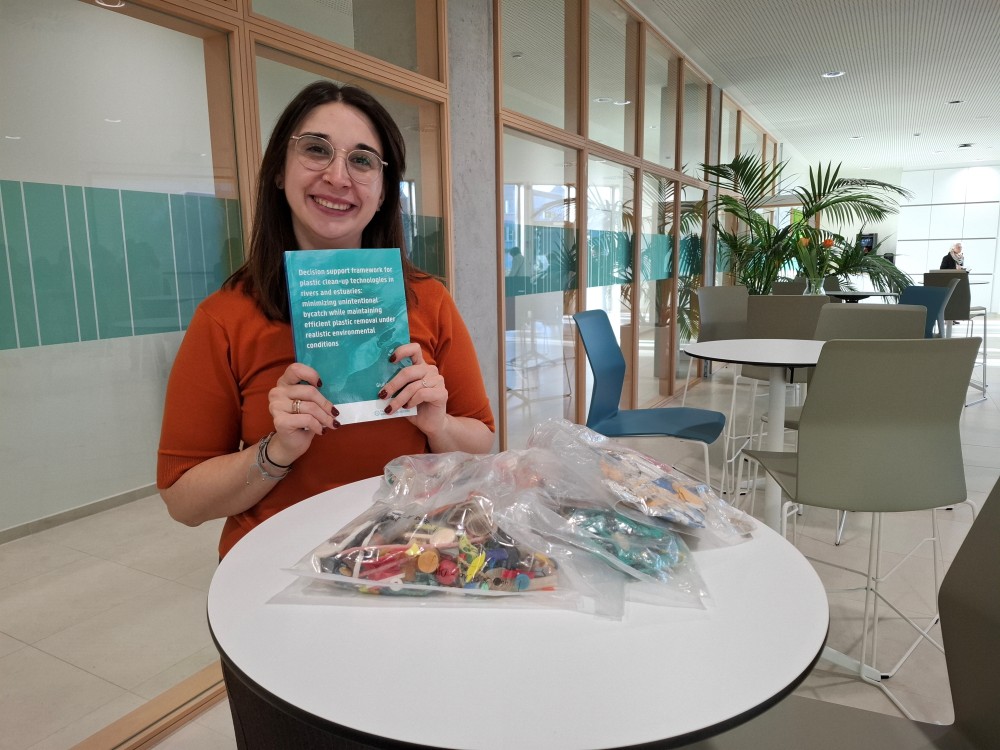
Plastic pollution remains one of the most pressing social and environmental challenges worldwide. In response, a range of mitigation strategies have been implemented including policy interventions and legislative frameworks, the development of alternative materials, and technological innovations aimed at removing existing plastics from the environment. In her PhD thesis defended on December 3 2025, Giulia Leone (VLIZ, Ghent University, INBO, FWO), a FWO strategic basic research fellow (project 1S13522N/1S13524N), investigated the efficiency of these techniques for removing plastic, mainly focusing on the potential unwanted bycatch and on the perception by public and key stakeholders.
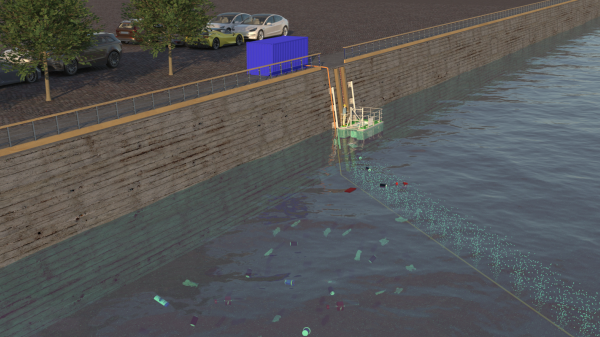
Plastic clean-up technologies are strategies aiming to clean up plastic pollution, but there is currently a lack of knowledge on their potential environmental impacts, both positive and negative. Therefore, attention should be provided to understand and address plastic catch and bycatch from plastic clean-up technologies.
However, due to the novelty and diversity of these technologies, empirical data on their potential positive or negative impacts remain limited. These knowledge gaps also arise from the complexity of multiple interacting factors that can influence outcomes. For instance, each producer or user may employ a specific design and configuration of a clean-up mechanism, which is often adapted to the unique environmental conditions of each deployment area. The interplay between technology design, operational configurations and local environmental conditions can therefore shape both positive and negative impacts. This multidisciplinary PhD-work investigated the role of plastic clean-up technologies as strategies to mitigate plastic pollution, examined public and stakeholder perceptions, offered experimental insights into the factors that could contribute to the bycatch of plant-derived items, and presented a tool that can provide insights in the probability of plastic catch and bycatch, based on selected operational and environmental parameters.
Giulia made a comprehensive assessment of over a hundred different plastic remediation technologies (both prevention and clean-up technologies), showing that there is no one-size-fits-all solution. Due to the wide variety of local conditions, a multitude of technologies and solutions are needed to solve a complex issue such as plastic pollution. Most devices focus on macrolitter, and are used in inland waters such as rivers. From a survey of nearly a thousand citizens, she concluded that almost half of those questioned were familiar with the concept of plastic clean-up technologies, although less than 10% had seen a device in real life. Overall participants perceived these technologies as having a positive impact in the environment in which they are deployed. In contrast to being familiar with the existence of the technologies, there was much less knowledge on potential negative impacts in the environment in which they are deployed. In an experimental flume (department of Civil Engineering of Ghent University), Giulia investigated factors that may influence bycatch from plastic clean-up mechanisms. Following, she developed a tool, based on a probabilistic modelling method (using Bayesian Belief Networks), which could assist stakeholders in selecting the best-suited mechanism. This method can provide information to maintain the benefits while minimizing the potential negative effects, specifically bycatch. These models can also enable stakeholders to understand the preferable environmental conditions for operations before the actual deployment. Her work raises new questions and opens the door to other projects seeking solutions to the plastic problem in aquatic environments.
PhD and supervision
Guilia Leone's PhD was carried out at the Flanders Marine Institute (VLIZ), Ghent University (Faculty of Bioscience Engineering) and the Research Institute for Nature and Forest (INBO) under the supervision of Prof. dr. ir. Peter Goethals (UGent), Dr. Ana Isabel Catarino (VLIZ), Prof. Dr. ir. Gert Everaert (VLIZ) and Dr. Ine Pauwels (INBO). Giulia Leone was a FWO fellow (project 1S13522N/1S13524N).
Reference: Leone, G. (2025). Decision support framework for plastic clean-up technologies in rivers and estuaries: Minimizing unintentional bycatch while maintaining efficient plastic removal under realistic environmental conditions. PhD Thesis. Ghent University, Faculty of Bioscience Engineering: Gent. ISBN 9789463579070. 293 pp. [VLIZ-bib]