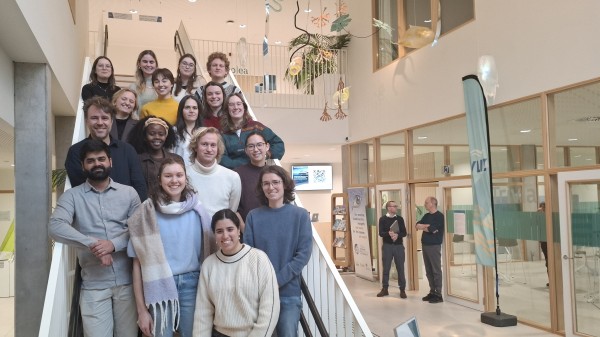
For her PhD research, geologist and oceanographer Alice Ofélia Matossian (Ghent University) made extensive use of the VLIZ fleet of underwater robots and its scientific expertise. Thanks to this collaboration, an important step has been taken towards understanding how large sediment accumulations form on the seafloor of the Atlantic Ocean.
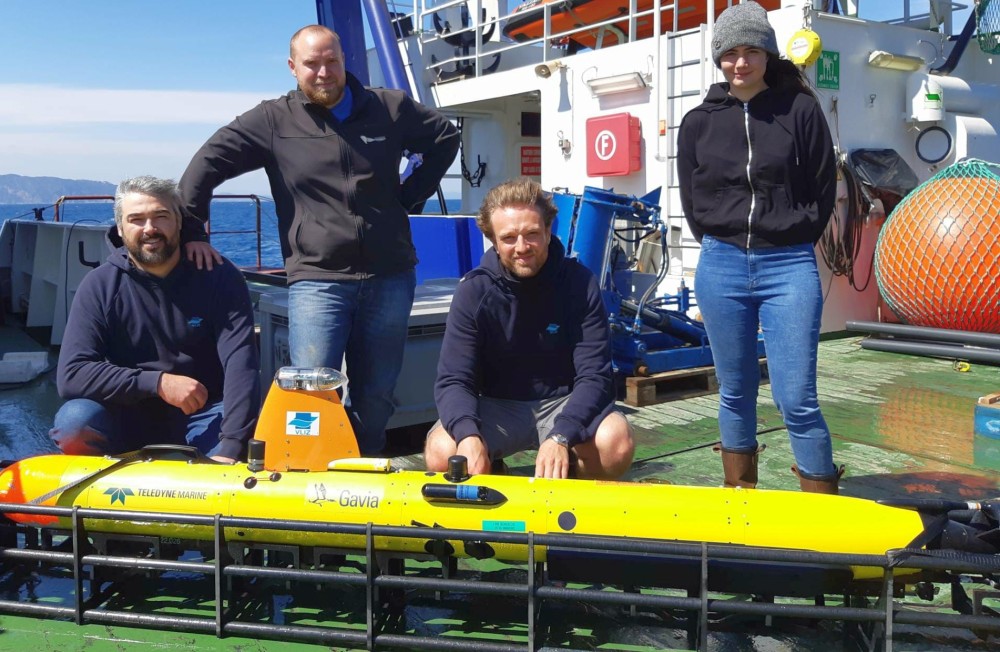
Staff of Marine Robotics Centre (VLIZ) and Alice Ofélia Matossian (UGent) with AUV Barabas on sampling campaign for DynaMOD project. Credit: VLIZ | Wieter Boone
Deep off the Irish coast lies the Belgica Mound Drift – a mysterious seabed ‘ridge’ enclosed by cold-water coral mounds and steep slopes. In her PhD thesis, Ghent University researcher Alice Ofélia Matossian unravels which currents are still reshaping this ridge today, and what this reveals about its recent past. Mapping the seafloor and ocean currents down to depths of 800 metres required advanced technology, including the expertise and fleet of underwater robots operated by VLIZ.
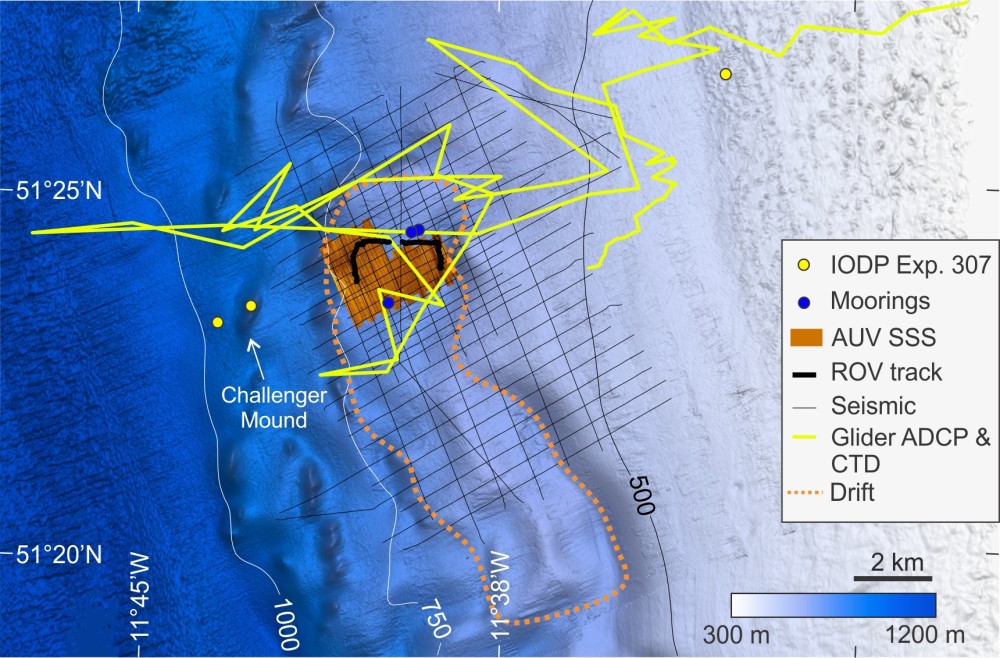
Map showing the Belgica Mound Drift (orange dashed outline) and the locations of the various datasets: IODP drill sites (yellow dots), seismic lines (black), the glider Yoko track (yellow) and ROV Gobelijn track (black), moorings (blue dots), and AUV Barabas side-scan sonar coverage (orange). Credit: from Matossian (2025).
Large sediment drifts – accumulations of sediment shaped by bottom currents – often reflect large-scale regional oceanographic processes, influenced by global climate change. Smaller drifts covering less than 100 km² are far more sensitive to local interactions between bottom currents, water masses and seafloor topography. This makes them a goldmine for researchers seeking to reconstruct local environmental history: they preserve a detailed archive of how currents, past and present, have transported sediment under climate-driven influences.
A striking example is the Belgica Mound Drift in the Porcupine Seabight (Northeast Atlantic Ocean, off the coast of Ireland). Covering approximately 36 km² – comparable in size to the historic city centre of Ghent – the drift lies at depths of 500 to 800 metres, wedged between cold-water coral mounds and a steep continental slope. At these depths, two major water masses meet: Eastern North Atlantic Water (ENAW) and Mediterranean Outflow Water (MOW). This makes the Belgica Mound Drift one of the most remote locations where the influence of Mediterranean water is still recognisable in the sedimentary architecture.
Using high-resolution seismic data collected aboard RV Belgica, Alice Ofélia Matossian reconstructed the drift’s history in three phases. First came a pre-drift phase (Pliocene–Early Pleistocene, around 2.7 million years ago), marked by a major regional erosional event that shaped the seafloor. This was followed by an initiation phase (Early–Middle Pleistocene, around 1.8 million years ago), during which the drift developed two separate growth centres, controlled by the ancient erosional surface and nearby cold-water coral mounds. Finally, a build-up phase (Middle Pleistocene to present) saw longer periods of sediment accumulation, likely enabled by weakening bottom currents and increased sediment supply.
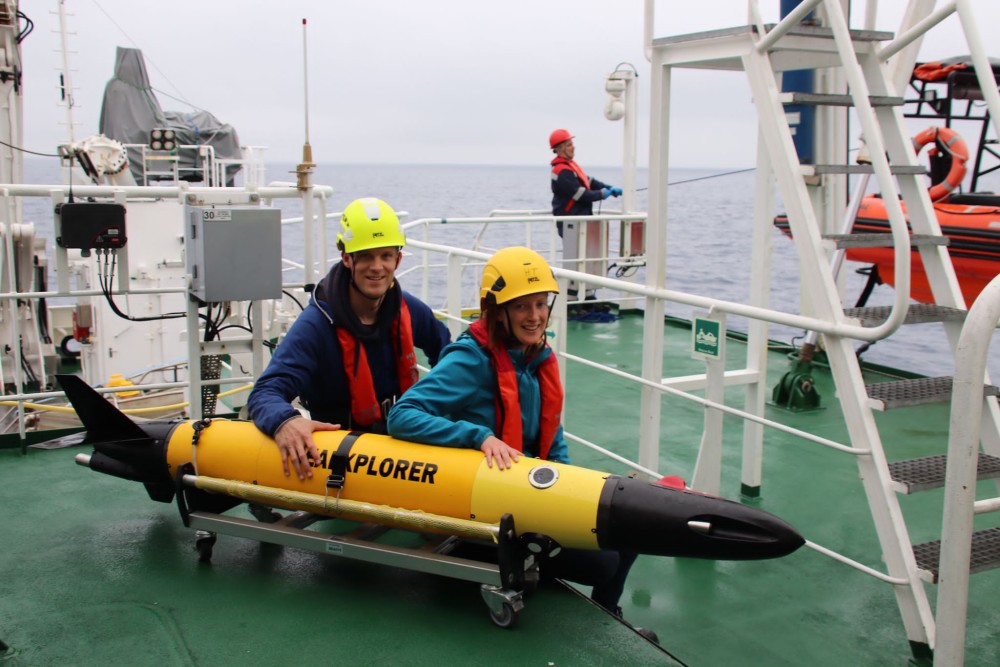
VLIZ staff with glider Yoko aboard RV Belgica - Credit: David Van Rooij | UGent
And the process is far from static. Current measurements from an oceanographic mooring operated by the University of Galway (Ireland), combined with data from the VLIZ glider Yoko, show that strong near-bottom currents are still present today, reaching speeds of up to 50 cm per second. These currents are driven by tidal motion around the ENAW–MOW transition zone.
Close to the seabed, an Ekman transport layer was also observed – a boundary layer that deflects and weakens the flow, subtly altering sediment transport. Seafloor imagery collected by the VLIZ robots ROV Zonnebloem and AUV Barabas reveals sediment waves and ripples, marking locations where currents rework sediment on a daily basis and where short-lived peak flows have left their imprint – not always detectable in current-velocity time series.
High-resolution data gathered by ROV Zonnebloem, AUV Barabas and glider YOKO demonstrate how local flow patterns, topography and tides together build up – and continuously rework – a small sediment body. Thanks to a multidisciplinary approach combining underwater robotics, seismic acoustic measurements and moorings, researchers can not only read the geological past more accurately, but also quantify the present-day dynamics of deep-sea bottom currents in unprecedented detail.
This research, focusing on the Belgica Mound Drift off the Irish coast, was carried out within the FWO-funded DynaMOD project, led by Prof. David Van Rooij (Ghent University), in collaboration with VLIZ and the University of Galway. The VLIZ robots were deployed from both the former and the new RV Belgica. VLIZ researchers involved in this work include Thomas Vandorpe, Wim Versteeg, Hannelore Theetaert, Kobus Langedock, Fred Fourie, Roeland Develter, Leandro Ponsoni, Christophe Maier and Wieter Boone.
Read more
- Unraveling the role of oceanographic forcing on a small-scale contourite drift: Onset, evolution and present-day sedimentary processes of the Belgica mound drift. PhD. Matossian (2025). | VLIZ-bib
- Evaluation of present-day hydrodynamic processes associated to the Belgica Mound contourite drift, offshore Ireland. Matossian et al. (2026) | VLIZ-bib
Morphosedimentary evolution of the Belgica Mound Drift: Controls on contourite depositional system development in association with cold-water coral mounds. Matossian & Van Rooij (2024) | VLIZ-bib