Sometimes small, basic actions can drive significant change. A decade ago, VLIZ began a seemingly modest initiative that would grow into world-renowned climate research: from ICOS to the IPCC – a VLIZ story about a small, hard-to-measure gas in the ocean and its global impact.
Climate change is one of the biggest challenges of our time, with the ocean at its heart. The ocean acts as the ultimate climate regulator by absorbing about 90% of the excess heat from greenhouse gas warming and about 25% of annual anthropogenic CO2 emissions. It also bears the consequences of this buffering and of the changing climate. Ocean acidification, marine heat waves, deoxygenation and rising sea levels are stressing our marine ecosystems and coastal areas.
Since 2015, VLIZ has monitored the ocean’s role in Earth's climate through its participation in the Integrated Carbon Observation System (ICOS). VLIZ operates and manages two coastal ICOS Stations with complementary features: the coastal research vessel RV Simon Stevin (BE-SOOP-Simon Stevin) as a Ship of Opportunity for underway measurements and the VLIZ Thornton Buoy (BE-FOS-Thornton Buoy) as a Fixed Ocean Station. Together, these platforms underline VLIZ’s contribution to the Ocean Carbon Value Chain.
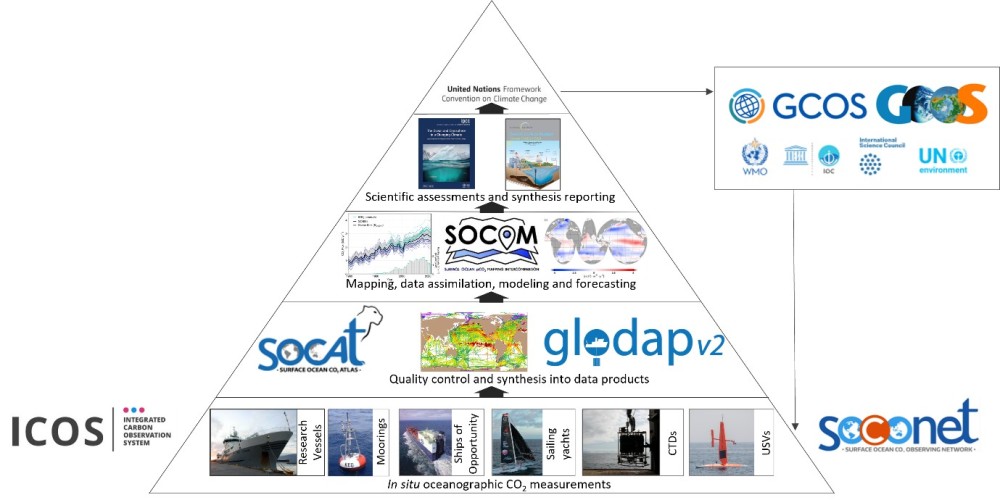
This infrastructure enables a comprehensive and timely understanding of carbon chemistry dynamics in the observed area. These efforts are visible across Europe via active participation in the ICOS Ocean community and extend globally through substantial contributions to the Surface Ocean CO2 Observation Network (SOCONET) and the Surface Ocean CO2 Atlas (SOCAT).
This commitment was underscored when one of the largest intercomparison activities for CO2 systems (lead by ICOS Ocean Thematic Centre) took place at the VLIZ facilities in the summer of 2021. VLIZ also hosted an Ocean Carbon Value Chain meeting in November 2023, bringing together the three basic tiers of the value chain pyramid and resulting in the “Ostend Declaration in Operationalising the Surface Ocean Carbon Value Chain”.
In parallel, participation in European funded projects such as RINGO, GreenFeedBack, GEORGE and NUBICOS solidified VLIZ’s position within the ICOS community and the wider marine greenhouse gas observations and biogeochemistry landscape.
In 2022, when VLIZ launched the Past, Present and Future (PPFC) climate research group, the Belgian Part of the North Sea was already among the best-observed exclusive economic zones worldwide. The next challenge was to move up the value chain.
Building on new artificial intelligence tools – supported by the Horizon Europe funded AI4PEX project and the Schmidt Sciences funded InMOS project – VLIZ research provided data-driven estimates for high impact assessments such as the Global Carbon Budget, playing a key role in carbon cycle research and policy implementation.
Among many fruitful scientific outcomes, highlights include publications in Science, Nature Reviews, Earth and Environment, and Nature Climate Change.
The quality and global significance of VLIZ’s work were further recognized by the IPCC, which nominated Peter Landschützer – VLIZ research director and head of the PPFC group – as a lead author for the 7th Assessment Report.
Beyond fundamental research, VLIZ’s carbon cycle work gained traction. Blue Economy projects like BERNARDO lift this expertise to the next level: user-driven concepts and the use of new tools and autonomous technologies boost the observational capacity.
On top of that, the ocean is increasingly promoted as part of climate solutions. Offshore renewable energy projects, the rise of the marine restoration economy, and blue carbon initiatives, receive growing attention as potential pathways to meet climate objectives. However, we still lack the background knowledge needed to quantify additionality effects of human activities on the marine carbon cycle. VLIZ therefore aims to pioneer high-resolution regional carbon budgets to be ready to monitor a decarbonising society.